
By Lorraine Langan
Oh deer! Yes, I’m talking about the four-legged kind. This graceful creature has embellished many of our Christmas cards, decorating gear, and often appears in many videos on social media. Why do we buy plastic deer to light up our front yards? What do we really know about them? Yes, we love to look at them, and sometimes catch a glimpse while taking a winter stroll or driving through the country, but do we know their habits? Probably not. So, I would like to take a moment to pay homage to this amazing creature.
I discovered that these animals are a very important part of NH history. When Europeans first settled in NH, the deer were in great supply. It was an important source of food, clothing and tools made from the antlers. The abundance of deer herds was probably taken for granted, and no one could imagine that the supply would eventually become greatly reduced, which, of course it did. In southern New Hampshire the deer remained plentiful up to about 1700. In the 1800’s and early 1900’s, they were wiped out from unregulated hunting. In 1923, there were only an estimated 1,000 deer in the state and plans were made to buy deer to expand the herd.
In our modern times, the deer are protected by NH Game and Wildlife Management. In a state website published in 2023, the population in NH has risen to “approximately 100,000”. This number is distributed throughout the State, with careful attention to the Southeastern area, where deer population control is underway to reduce the frequent deer vehicle collisions.
To further support the cause, the NH Fish and Game Department began the process of revising its 10-year management plan for white tailed deer in 2014. This document, called the NH Game Management plan, spans the period of 2016-2025. Goals have been adjusted to more closely monitor biological conditions, as well as public interests. Hunting, although not popular to some, is used as a tool for population management and provides recreation and lean meat to residents.
If you have ever seen a deer, you will agree that the white-tailed deer are a sight to see, with a tan to reddish brown color, and during the winter a grayish brown, and fluffy white tail. The species got its name because it shows the white underside of its tail is as a warning of danger to other individuals. The belly, throat, noseband, eye ring and inside of the ears are also white. The males have antlers while the females do not. The animal’s sizes vary considerably, with mature bucks weighing between 150-300 pounds and a doe between 90-210 pounds.
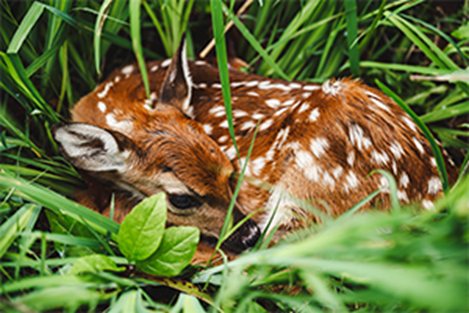
Here are a few more facts: The breeding period in the Northeast peaks in November. In NH, breeding is somewhat consistent and roughly 80% takes place over a three-week period starting in mid-November. Groups of bucks’ form then split up and follow a doe’s scent from 150 feet. The dominant buck may compete with others and mate with several does. After mating, the doe will return to its group. Females typically give birth to one to three spotted fawns in mid to late Spring. The fawns lose their spots during the first summer and weigh 44 to 77 pounds by the first winter. For the first four weeks, the mother keeps the fawns well-hidden and nurses them four to five times a day. She will wander and feed, but not too far from her young. Hiding them keeps them away from cougars and wolves. After about a month, the fawn will follow Mom on foraging trips, and this is often the time you may catch a view of a Doe and her fawns.
I have only touched the surface of this subject, there is so much more to learn about the survival instincts of this animal, who we are so fortunate to share our forests with. I am sure many of you have seen them grazing along the sides of roads and farmland. You may want a closer look, a winter adventure. Get outdoors and onto the Pelham Trails. You will be glad you did.
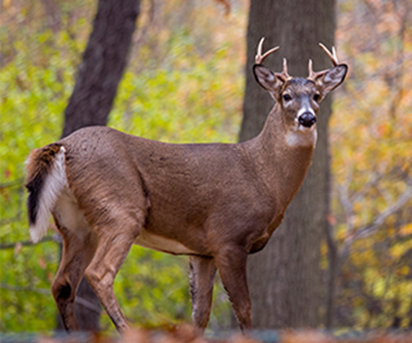
A Young Buck
There are 22+ miles of trails to explore:
- Costa Conservation Area
- Cutler-Spalding Conservation Area
- Cutter-Merriam Conservation Area
- Elmer G. Raymond Memorial Park
- Gumpus Pond Conservation Area
- Kirby-Ivers Town Forest
- Little Island Pond Conservation Area
- Merriam Farm Conservation Area
- Peabody Town Forest
- Spring Street Town Forest, Mosse Pond, Calitri Conservation Area
- Wolven Park
Don’t let the winter cold keep you in the house. There is beauty all around us. Get out, get your children out and away from computer games and technology. Enjoy the streams, ice-covered ponds, snow covered rock formations and the wildlife that surrounds you. You never know, you may be lucky and see a Doe with her fawn foraging for food, or a buck drinking from a pond.
Enjoy your time on the trails!
For trail maps: https://pelhampathways.com/communitytrailcoalition/maps-and-tours/
For the Winter Hike Challenge: Pelhampathways.com/Community Trail Coalition/Getting Started/


Leave a comment